If you train consistently for endurance events, sports nutrition quickly becomes a noticeable line item in your monthly budget. Sachets of high-carb drink mix can easily cost £2 to £3 each. When you are aiming for 60 to 90 grams of carbohydrate per hour across multiple long sessions a week, the cost adds up fast.
I’ve had a few of my coached athletes ask me about this and recently, I’ve decided to test it myself. A simple, low-cost alternative that has been circulating online: making your own carb drink using standard sugar, water, and a pinch of salt.
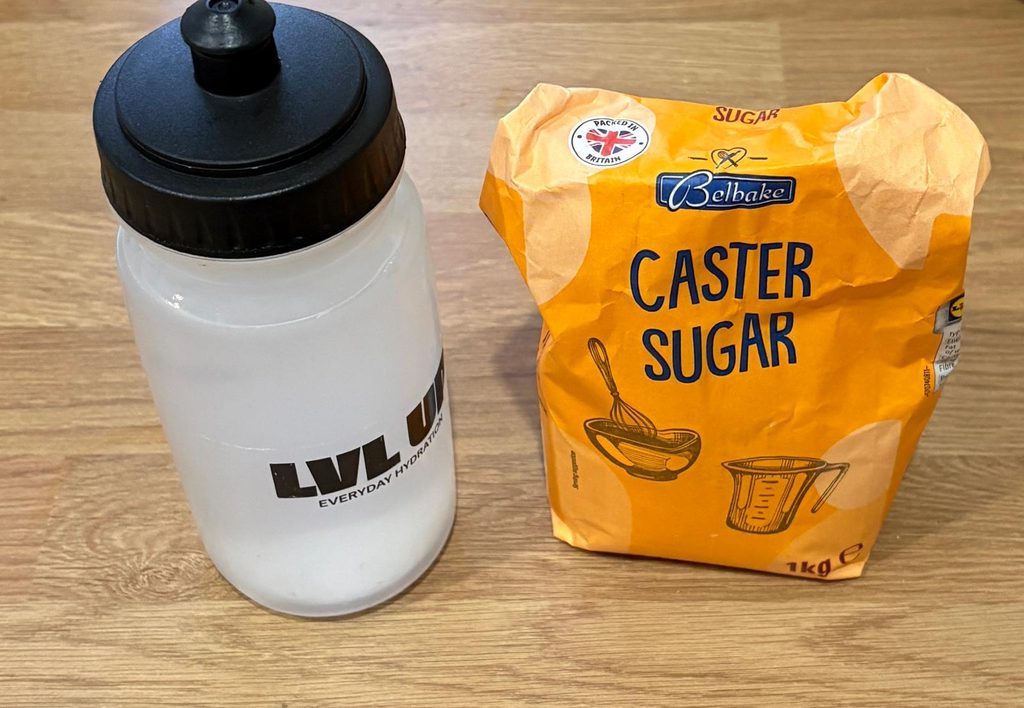
The basic recipe is straightforward:
- 60g of white table sugar
- 750ml of water
- A pinch of salt (around 0.5g)
It costs pennies per bottle. But from a physiological perspective, how does it actually compare to premium sports drinks, where are the trade-offs and what do I actually think of it?
1. The Carbohydrate Ratio (Why It Works on Paper)
The primary reason this DIY mix works is simple biochemistry.
Table sugar is sucrose. Sucrose is a disaccharide made of one glucose molecule and one fructose molecule bonded together. Once digested, it breaks down into an exact 1:1 ratio of glucose to fructose.
Most premium endurance drinks use a ratio between 1:0.8 and 2:1 (glucose/maltodextrin to fructose).
The body uses different intestinal transporters to absorb carbohydrates:
- SGLT1 transports glucose (saturating at roughly 60g per hour).
- GLUT5 transports fructose (absorbing roughly an additional 30–45g per hour).
By using dual carbohydrate sources, you bypass the bottleneck of single-source glucose, allowing your gut to absorb more fuel per hour with less discomfort. At a 1:1 ratio, plain table sugar is remarkably close to what high-end nutrition brands formulate.
2. The Trade-offs: Why Commercial Mixes Still Exist
While table sugar gets the carbohydrate ratio right, there are two key physiological differences between standard kitchen ingredients and purpose-built sports drinks:
Osmolality and Gastric Emptying
Commercial endurance mixes rely heavily on maltodextrin rather than plain sugar. Maltodextrin is a complex carbohydrate made of long chains of glucose molecules.
Because osmolality (the concentration of dissolved particles in a liquid) is determined by the number of molecules rather than their physical weight, a maltodextrin solution has a much lower osmolality than a simple sugar solution with the same calorie content.
- Lower osmolality allows fluid and carbohydrates to empty from the stomach faster and draw less water into the bowel.
- Higher osmolality (pure table sugar) can slow gastric emptying and increase the risk of bloating, sloshing, or gastrointestinal distress, especially at higher concentrations or higher exercise intensities.
Sodium Chloride vs. Sodium Citrate
A pinch of standard table salt provides sodium chloride.
Most dedicated sports hydration products use sodium citrate instead. Sodium citrate has a much milder, less harsh taste, and is generally gentler on the stomach lining during hard efforts. Table salt can quickly make a drink taste overly briny, which becomes difficult to tolerate several hours into a session.
Taste and Sweetness Fatigue
Table sugar is significantly sweeter than maltodextrin. At 60g in a 750ml bottle, the sweetness is manageable. If you try to scale that up to 80g or 90g per bottle for a hard long-distance ride, the taste can become cloying and unpalatable very quickly.
What is my take on it?
I’ve tried this on most of my training sessions for the past month: 60g of sugar, a little table salt and 750ml of water.
My conclusion that it is super effective and I’ve personally not had any negative effects from it.
I would occasionally get a sticky feeling with one of the carb drinks I was using in the past on really hard sessions and I’ve not had that once.
Energy levels wise I feel just as good as if I’d taken on a typical ‘carb drink’.
It is a very sweet taste but I’ve grown to actually really like it. My other half was worried about the effect that it could have on teeth but actually my research suggests that it is better on teeth than a commercial drink because it doesn’t use acids to take away from the sweet taste so has a much more neutral pH level.
How to Apply This in Your Training
You don’t need to spend top-tier money on every routine mid-week training session. Here is a practical way to think about using DIY mixes:
- Use it for routine, low-to-moderate intensity sessions: A 60g table sugar mix in a 750ml bottle works very well for steady zone 2 rides or easy endurance sessions where your stomach isn’t under heavy stress.
- Don’t push high concentrations without testing: If you need 80–90g/hr for race-specific training, pure table sugar will likely test the limits of your gut comfort due to high osmolality and intense sweetness.
- Keep race day specific: If you plan to use a commercial product on race day (or whatever is provided on the course), make sure your gut is fully adapted to that specific fuel in your key race-pace sessions.